
Opening a Business Bank Account in Qatar
How to prepare for a Qatar corporate bank account: documents, KYC, ownership, source of funds, process and common delays.
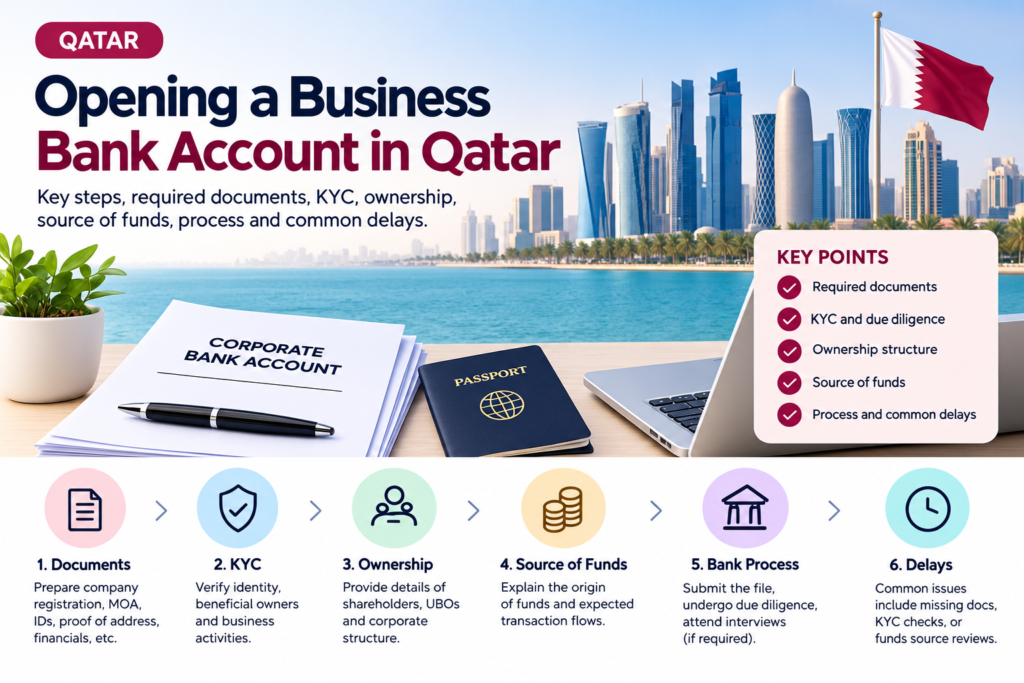
- In this article
Opening a Business Bank Account in Qatar
For a foreign-owned company, opening the corporate bank account is often one of the most practical parts of the setup process. Incorporation creates the company, but the bank still needs to understand who owns it, who controls it, what it does, where its money comes from and how the account will be used.
The best strategy is to prepare the banking file while the company is being formed, rather than waiting until the day the commercial registration is issued.
When to start the banking process
Start by identifying the likely bank requirements and the documents your chosen entity will produce. The exact sequence varies by bank and company type. QNB, for example, lists the commercial registration, commercial licence, tax card, establishment card, constitutional documents, partner and authorised-signatory identity documents, mandate or board resolution and KYC/tax-residency forms among its corporate-account requirements.
How company structure affects banking
A straightforward operating company with clear ownership, a defined local activity and transparent contracts may present a different risk profile from a holding company, newly incorporated foreign-owned entity, regulated business or company whose shareholders are spread across several jurisdictions.
This does not mean one structure is automatically easier to bank. It means the banking file should make commercial sense and match the legal structure.
Documents and KYC requirements
Expect the bank to look beyond the certificate of incorporation. A strong file can include an ownership chart, beneficial-owner information, passports and IDs, company constitutional documents, commercial registration and licence, tax documents, establishment documents, business plan, contracts or expected customer relationships, source-of-funds information and projected account activity.
For a foreign investor, source-of-funds evidence and a clear explanation of the business model can be particularly important. The goal is to make the expected transactions understandable before the bank has to ask repeated questions.
The account-opening process
There is no reliable universal “one-week” or “six-week” guarantee. Timing depends on the completeness of the file, ownership complexity, business activity, compliance review and bank workload.
Why applications are delayed or rejected
Common problems include inconsistent shareholder information, unclear beneficial ownership, unexplained source of funds, unrealistic projected transactions, missing constitutional documents, insufficient evidence of the operating business, incomplete tax-residency information and choosing an account type that does not fit the company.
A bank may also ask questions because the company is newly incorporated. New companies do not have a long transaction history, so the business plan and supporting evidence become more important.
What to prepare before approaching a bank
Create a concise banking pack: company profile, ownership chart, founder biographies, activity description, target markets, expected incoming and outgoing payments, expected monthly turnover, key contracts or proposals, source-of-funds explanation and supporting documents. Make sure every figure is consistent across the company documents and application.
Opening a corporate bank account is best treated as a due-diligence exercise rather than a final administrative formality. A bank wants to understand who owns the company, who controls it, what the company actually does, where its money will come from, who its customers are likely to be and how the account will be used. A newly formed company with a clear commercial story and consistent documentation is easier to assess than one that has only a registration certificate.
The banking file should normally be prepared alongside incorporation. Depending on the bank and entity, this can include the commercial registration, commercial licence, tax card, establishment card, constitutional documents, shareholder and director identification, beneficial-owner information, board or management resolutions, tax forms and evidence supporting the source of funds. Banks can ask for additional information, so the exact list should be confirmed with the chosen institution.
The business model should be expressed in practical terms. Instead of saying “international consulting,” explain the services, target customers, countries of operation, expected monthly transaction volume, expected incoming and outgoing currencies and major suppliers. If the company will receive funds from an overseas parent, explain the ownership and intercompany relationship. If it will process customer payments, explain the payment flow. This makes the KYC review more coherent.
Source of funds is particularly important for newly incorporated businesses. The founder should be able to explain the initial capital, where it came from and how it will be transferred. Supporting bank statements, investment agreements or corporate records may be relevant depending on the circumstances. A mismatch between the stated funding source and actual account activity can trigger further review.
Banking should also influence the choice of structure. If the business expects to invoice customers in several currencies, receive international payments or operate across multiple jurisdictions, ask in advance about the bank's supported currencies, transfer procedures, online banking, payment limits and documentation requirements. A company structure that is legally valid but difficult to bank may be commercially inconvenient.
The safest sequence is: select the activity and entity; prepare ownership and business documents; identify suitable banks; build the KYC file; submit the application; respond promptly to clarification requests; and only then scale the account activity in line with the business plan. Banking is not guaranteed merely because a company has been incorporated, so it should be planned from the beginning.
What banks are really checking: KYC, ownership and source of funds
Opening a business bank account is not simply a document-upload exercise. The bank needs to understand the customer and the risk presented by the account. KYC means “Know Your Customer”, and the review can cover the legal entity, shareholders, authorised signatories, ultimate beneficial owners, tax residence, business activity and expected transactions. QNB's published corporate-account requirements, for example, include KYC and tax-residency forms alongside corporate documents.
Source of funds is another central part of the file. A founder should be able to explain where the initial capital comes from and provide supporting evidence that is consistent with the explanation. Depending on the circumstances, that evidence may include bank statements, audited accounts, sale agreements, investment documents or other credible records. The important principle is consistency: the amount entering the Qatar company should make sense against the stated source of funds and the business plan.
The beneficial owner should be mapped clearly. If the Qatar company is owned by an overseas company, prepare a simple ownership chart showing each entity and individual until the ultimate beneficial owners are identified. Also align the CR, articles, board resolutions and bank mandate so that the people presented to the bank have the authority that the corporate documents say they have.
Explain the business model and expected transactions
A new company can face questions simply because it has no transaction history. The solution is to explain the expected activity. Prepare a one- or two-page banking brief covering what the company sells, its main customer markets, supplier locations, expected monthly inflows and outflows, currencies, expected international transfers and the reason for each major payment type.
For example, a software company might explain that revenue will arrive by bank transfer from corporate customers in several countries, while payments will go to software suppliers, contractors and employees. A trading company should be ready to explain the goods, supplier countries, customer countries, shipping route and expected invoice sizes. A consulting business should explain its services, contract model and expected client base.
These examples are not guarantees of approval; they simply demonstrate the level of commercial clarity a bank may need.
Why applications can be delayed or declined
There is no single reason a bank application is delayed. Common practical issues include incomplete corporate documents, unclear ownership, inconsistent addresses or names, missing tax-residency information, an unexplained source of funds, an activity that does not match the expected transactions, or a business model that is too vague for the bank's risk assessment. A bank may also ask for additional information after its initial review.
The strongest response is preparation rather than trying to “convince” a bank with promotional language. Provide accurate documents, answer questions consistently and keep evidence ready. If the bank asks for clarification about a large expected transfer, explain the commercial reason and provide the relevant contract or invoice trail where available.
FAQ
Can a foreigner open a business bank account in Qatar?
Foreign-owned companies can apply, but banks conduct their own KYC and eligibility reviews and may require specific documentation.
Does having a CR guarantee a bank account?
No. A bank makes its own compliance and onboarding decision.
Do I need a Qatar ID?
Requirements vary by bank and account type. QNB’s current online company-account process lists a valid registered QID and related-party verification for that route.
How long does corporate banking take?
There is no universal timeframe. Preparation quality, ownership, activity and compliance review can affect timing.
Prepare the formation and banking file together
Banking should influence the formation sequence from the start. A professional formation plan can help ensure that the company’s stated activity, ownership documents, licences and expected transactions tell one consistent story.
Get help preparing your formation and banking file, with documents aligned to typical KYC expectations.
The bank-account application should be treated as a presentation of the company to a regulated institution. A concise corporate profile can help: business description, target market, ownership, management team, expected revenue, expected transaction volume, major counterparties and source of initial funding. Supporting documents should be labelled and consistent.
Founders should avoid applying with an account-use description that is too broad. If the company expects to receive software subscription revenue, international consulting fees or trading proceeds, explain the actual flow. The bank may ask for customer contracts, invoices, websites, business plans or other evidence. These requests are normal parts of KYC rather than evidence that the company has been rejected.
It is also worth asking whether the bank can support the company's practical requirements: multiple currencies, international transfers, online approvals, salary payments, corporate cards and transaction limits. A business that expects international activity should assess these features before choosing a bank.
Finally, keep the bank updated when the business changes materially. A sudden increase in transaction volume, new countries, new shareholders or a new business activity can lead to questions. Proactive documentation is usually easier than trying to explain a large change after the fact.
Official sources
- Qatar Central Bank — https://www.qcb.gov.qa/
- QNB — https://www.qnb.com.qa/sites/qnb/qnbqatar/page/en/encorporateaccount.html
- Ministry of Commerce and Industry — https://www.moci.gov.qa/en/investment-steps
- QNB — Corporate Account Requirements — https://www.qnb.com/sites/qnb/qnbqatar/page/en/encorporateaccount.html