
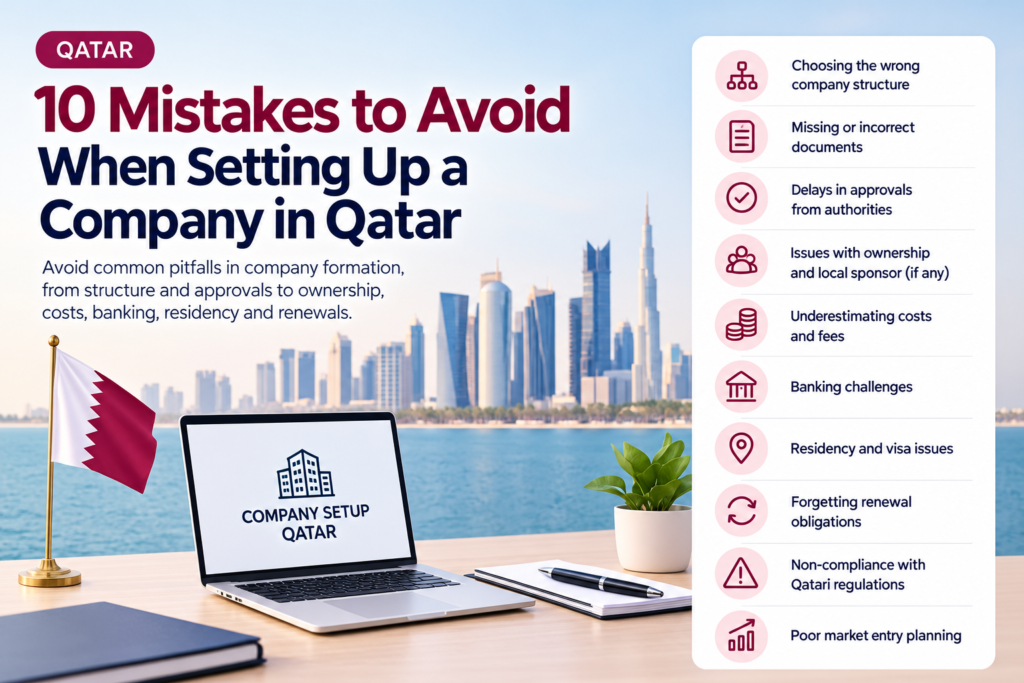
10 Mistakes to Avoid When Setting Up a Company in Qatar
Avoid common Qatar company-formation errors involving structure, approvals, ownership, cost, banking, residency and renewals.
- In this article
Key takeaways
Most company-formation problems are not caused by the existence of paperwork. They happen because founders make a decision too early: they choose a structure before checking the activity, rely on an outdated ownership rule, accept a low headline quote, assume a CR is an operating licence, or leave banking and residency until the end.
Choosing the structure on price or a tax headline alone
A low-cost registration or “0% tax” headline can be attractive, but it may not fit your customers, activity or market-access needs. Compare the structure against the actual business model, not the marketing headline.
How to check: identify customers, activity, premises, ownership, staffing and tax requirements before selecting the jurisdiction.
Choosing an activity without checking approvals
The activity is one of the foundations of the formation file. Some activities require additional approvals or specialised licences. A broad description such as “consulting” is not enough if the actual service falls within a regulated category.
How to check: identify the exact economic activity and verify the applicable approval path before incorporation.
Assuming 100% ownership is automatic
Qatar allows up to 100% foreign ownership in permitted sectors, but eligibility is activity-specific and some fields are excluded or require special authorisation. Do not treat 100% ownership as a universal rule.
How to check: use current MOCI foreign-investor guidance and the permitted-activity information.
Relying on outdated information
How to check: prioritise MOCI, Single Window, GTA, QFC, QFZ, MOI/Hukoomi and other official sources.
Underestimating the total cost
The registration fee is only one part of the budget. Office or address costs, activity licences, immigration, accounting, tax compliance, banking preparation and annual renewals can materially change the total.
How to check: request a year-one and recurring-cost estimate with each item clearly separated.
Not planning the office or address properly
Certaines entreprises ne peuvent pas exercer leur activité simplement parce qu’elles disposent d’un certificat d’immatriculation commerciale (CR). Un permis commercial et des locaux adaptés peuvent également être nécessaires. Le guichet unique Single Window distingue clairement l’immatriculation de l’autorisation d’exercer l’activité.
Comment vérifier : confirmez les exigences relatives aux locaux et à l’adresse professionnelle avant de signer un contrat de location.
Underestimating banking requirements
A bank needs more than a company certificate. Ownership, beneficial ownership, source of funds, expected transactions, constitutional documents and business evidence can all matter.
How to check: build a banking pack before approaching the bank.
Assuming a company automatically means residency
Company formation does not automatically guarantee a residence permit. Qatar now has specific entrepreneur and executive residency programmes as well as other immigration routes, each with its own eligibility conditions.
How to check: identify the correct immigration route separately from the company-formation route.
Forgetting annual renewals
Formation is the beginning of the compliance cycle. Commercial registrations, licences, immigration documents and other approvals can have renewal obligations. Tax and accounting responsibilities also continue after incorporation.
How to check: maintain a compliance calendar from the first month of operation.
Starting without understanding ongoing obligations
A company needs more than a licence. Depending on the structure and activity, ongoing obligations can include accounting records, tax filings, beneficial-ownership information, labour requirements, licence renewals and banking updates.
How to check: ask for a post-formation compliance checklist before the company is launched.
Pre-launch checklist
Before submitting the formation application, confirm: exact activity; ownership eligibility; legal structure; jurisdiction; premises; required approvals; founder and employee immigration plan; estimated year-one cost; recurring costs; banking requirements; tax registration; beneficial ownership; and renewal dates.
The ten mistakes in this checklist are connected. Choosing the wrong activity can lead to the wrong licence; the wrong licence can lead to the wrong premises; the wrong premises can delay launch; and an unclear business model can make banking harder. Treating each decision separately is therefore less effective than designing the complete formation sequence before submitting the first application.
A strong pre-launch file should contain an activity list, ownership chart, proposed legal structure, jurisdiction rationale, premises plan, founder and employee immigration plan, first-year budget, banking checklist, tax-compliance plan and renewal calendar. This is effectively a project plan for the company. It also makes it easier to compare service providers because every provider can be asked to quote against the same scope.
Another common problem is assuming that the formation provider controls every part of the process. Some steps are authority decisions, some depend on landlords or banks, and some depend on the founder supplying accurate documents. A professional adviser can coordinate the process, but the entrepreneur remains responsible for giving complete information and responding to requests. Clear ownership of each task reduces last-minute delays.
Founders should also distinguish between “approved,” “registered” and “operational.” A company may be incorporated but still need a commercial permit, sector approval, premises, immigration documents or a bank account before it can operate normally. Marketing language that treats the first certificate as the end of the process can create unrealistic expectations.
Cost mistakes are equally avoidable. Request a written schedule that separates government fees, professional fees, premises, immigration, banking support, accounting, tax compliance and annual renewals. Then ask which amounts are one-off and which recur. This makes it possible to calculate the true cost of keeping the company active after the first year.
Finally, create a compliance calendar on the day the company launches. Record registration and licence expiry dates, tax deadlines, immigration renewals, accounting milestones and any sector-specific obligations. Assign a person responsible for each deadline and keep copies of submitted documents and payment receipts. A company that is well organised after formation is far less likely to lose time or money through an avoidable compliance problem.
The goal of a checklist is not to make formation complicated. It is to move important decisions forward so that the entrepreneur does not discover a structural problem after money has already been spent. The best checklist is the one that makes the final registration the predictable result of good preparation.
The 10 mistakes in practice
1. Choosing the structure on price or a tax headline alone. A low advertised package or attractive tax headline does not establish that a structure suits the business. Compare the activity, ownership rules, customer base, premises, licensing, banking and ongoing compliance before deciding. A structure that looks cheaper at incorporation can cost more if it requires later changes.
2. Choosing an activity without checking approvals. The licensed activity determines much of the formation pathway and may trigger sector-specific approvals, premises standards or additional documents. Define the intended activity precisely and check it with the relevant authority before paying a deposit or submitting an application.
3. Assuming 100% ownership is automatic. Qatar permits full foreign ownership in eligible cases, but the rules depend on the activity and applicable framework. Do not treat a general statement about foreign ownership as approval for every business. Verify the exact activity and any conditions before finalising shareholders and legal structure.
4. Relying on outdated information. Fees, procedures, eligibility rules and authority guidance can change. Advice from an old blog post or an undated provider page may no longer reflect the current process. Check the latest official government guidance and confirm requirements for the specific activity before acting.
5. Underestimating the total cost. Incorporation is only one part of the budget. Include licensing, premises, immigration, professional support, banking preparation, accounting, tax compliance and renewals. Ask providers for itemised quotes that distinguish official charges from service fees and identify one-time versus recurring costs.
6. Not planning the office or address properly. A low-cost address may not satisfy the selected activity or licensing framework, while an unnecessarily expensive lease can burden the business. Confirm the permitted premises arrangement and any inspection or fit-out requirements before signing a lease or committing to deposits.
7. Underestimating banking requirements. Banks may request ownership records, identity documents, source-of-funds evidence, expected transaction details and a credible business plan. Prepare the KYC file and explain how the company will earn and move money early, rather than waiting until after incorporation to assemble documents.
8. Assuming a company automatically means residency. Company formation and immigration approval are separate processes. Residence pathways can have their own eligibility, endorsement and documentation requirements. Check the relevant route and requirements for each person before treating relocation or a residence permit as guaranteed.
9. Forgetting annual renewals. Registration and licences may need renewal, while accounting, tax filings, immigration documents and other obligations can continue after the first year. Create a calendar with deadlines, responsible people and reminders, and budget for recurring charges instead of treating incorporation as a one-time project.
10. Starting without understanding ongoing obligations. Before launch, map the company’s continuing responsibilities for records, tax, payroll or immigration where relevant, sector approvals, ownership or activity changes and document retention. Assign responsibility for each task and obtain professional advice where needed so the company remains compliant after registration.
Registration alone does not solve operational readiness. Before filing, identify contracts, employee arrangements, the bank account, tax obligations, required operating licence and bank evidence. This makes formation part of the operating plan.
FAQ
What is the most common mistake?
Choosing the structure before properly defining the activity and market-access requirements.
Can I fix a wrong structure later?
Sometimes, but changes can involve new approvals, costs, contracts, banking work and operational disruption.
How do I verify current rules?
Start with the relevant official authority rather than relying on old provider articles.
What happens if I miss a renewal?
Consequences depend on the specific registration, licence or permit. Check the applicable authority’s current rules and deadlines.
Should I use a provider?
Professional support can be useful when the activity, ownership, licensing, banking or immigration sequence is complex. The value is in getting the structure and sequence right, not simply filing forms.
Conclusion
The safest Qatar company-formation strategy is deliberate rather than rushed. Define the activity, confirm ownership, choose the right jurisdiction, budget the whole first year, prepare the banking and residency files, and create a compliance calendar before launch.
Get a pre-formation review covering your structure, activity, costs and setup sequence.
The checklist becomes even more useful when each item has an owner and a deadline. The founder can own business-model and funding decisions; the formation adviser can coordinate filings; the landlord can provide premises documents; the bank handles its own KYC review; and the founder's accountant or tax adviser can manage recurring compliance. Writing this down prevents the assumption that one party is responsible for everything.
A second safeguard is a document-control system. Use consistent company names, shareholder names, passport details and addresses across forms. Keep the latest constitutional documents, licences, tax registrations and identification records together. When a document is replaced, archive the old version rather than allowing multiple conflicting copies to circulate.
Before launch, perform a “day one” test. Can the company issue an invoice? Can it sign its intended customer contract? Can it legally perform the activity? Does it have the required premises or permit? Can the founder and employees work under the intended immigration status? Is the bank account ready? Are tax and accounting responsibilities understood? If any answer is no, the business may be registered but not fully operational.
Si l’une de ces réponses est négative, l’entreprise peut être immatriculée sans être encore pleinement opérationnelle.
Official sources
Ministry of Commerce and Industry — https://www.moci.gov.qa/en/investment-steps
General Tax Authority — https://www.gta.gov.qa/en/laws
Qatar Financial Centre — https://www.qfc.qa/en/setup/limited-liability-companies/
Qatar Free Zones Authority — https://qfz.gov.qa/resource/faq/
Invest Qatar — https://www.invest.qa/en/residency-program
QNB Qatar corporate banking — https://www.qnb.com.qa/sites/qnb/qnbqatar/page/en/encorporateaccount.html
UAE Government — https://u.ae/en/
UAE Federal Tax Authority — https://tax.gov.ae/en/legislation/corporate.tax.aspx